
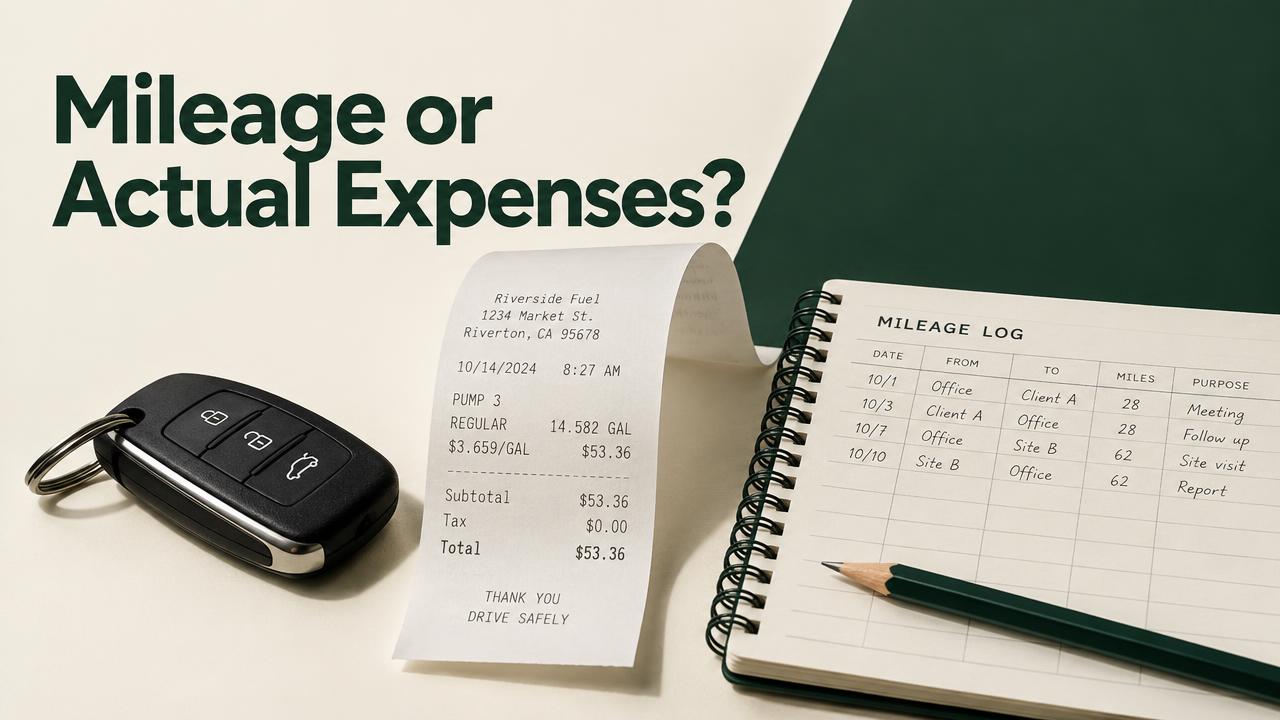
If you use a vehicle for business, you can deduct its costs using one of two methods: the standard mileage rate (a set rate per business mile) or the actual expense method (tracking all vehicle-related costs). The mileage rate is simpler, but tracking actual expenses could result in a larger deduction, especially if you have a costly vehicle or high maintenance bills.
Key Takeaways
- The Standard Mileage Rate offers a simplified, per-mile deduction that requires less record-keeping.
- The Actual Expense Method involves tracking every dollar you spend on your car for business, from gas and insurance to depreciation.
- To use the actual expense method, you must calculate your business-use percentage by tracking total mileage vs. business mileage.
- The choice you make in the first year you use a vehicle for business can lock you into that method (or a variation of it) for future years.
- Meticulous record-keeping is required by the IRS for either method you choose.
What Is the Standard Mileage Rate?
The standard mileage rate is the simple option. The IRS sets a specific rate per mile for business use each year. For 2026, you'll multiply your total business miles by this rate to get your deduction. It's designed to cover all the variable and fixed costs of operating your car, including gasoline, oil, insurance, repairs, and depreciation.
The big advantage here is simplicity. You don't need a shoebox full of gas receipts. You just need a reliable log of your business mileage, dates, and the purpose of your trips. Note that parking fees and tolls are not included in the rate; you can deduct those separately on top of your mileage deduction.
How Does the Actual Expense Method Work?
The actual expense method is exactly what it sounds like. You track, add up, and deduct the actual costs of operating your vehicle for business. This requires diligent record-keeping of every penny you spend.
Common deductible expenses include:
- Gasoline and oil
- Repairs and maintenance
- Tires
- Insurance
- Registration fees and licenses
- Car washes
- Lease payments (if you lease)
- Depreciation (if you own)
The catch is that you can only deduct the portion of these expenses that relates to business use. That brings us to a crucial calculation.
Calculating Your Business-Use Percentage
If you use your car for both business and personal trips, which is the case for most people, you must separate the costs. To do this, you need to find your business-use percentage. The formula is straightforward: (Total Business Miles / Total Miles Driven) = Business-Use Percentage.
For example, if you drive 20,000 miles in a year and 15,000 of those were for business, your business-use percentage is 75%. You would then multiply your total actual vehicle expenses (gas, insurance, etc.) by 75% to determine your deductible amount. This means you need a log of all miles driven, not just business ones.
Mileage vs. Actual Expenses: The Pros and Cons
Choosing a method is a trade-off between simplicity and potential tax savings. For the Standard Mileage Rate, the pro is easy record-keeping, while the con is that you might get a smaller deduction. For the Actual Expense Method, the pro is a potentially larger deduction, but the con is the significant administrative burden of tracking everything.
Special Rules and Restrictions You Can't Ignore
Here's a critical point: your first-year choice matters. If you own your car and choose the actual expense method using an accelerated depreciation method (like MACRS) in the first year, you are stuck with the actual expense method for the entire time you use that car for business. You cannot switch to the standard mileage rate later.
However, if you use the standard mileage rate the first year, you can switch to the actual expense method in a subsequent year. If you lease a vehicle, you must stick with your chosen method for the entire lease period.
Which Method Is Right for You?
Generally, the standard mileage rate may be more favorable if you drive a lot of miles for business in a fuel-efficient car with low maintenance costs. The high mileage count works in your favor.
The actual expense method often works out better if you don't drive as many miles but have a more expensive vehicle (leading to higher depreciation), poor fuel economy, or high maintenance and insurance costs. Think of a contractor's heavy-duty truck that has high upkeep but might not rack up tens of thousands of miles a year.
Record-Keeping Is Non-Negotiable
Whichever method you pick, the IRS demands proof. For mileage, that means a contemporaneous log showing the date, starting and ending odometer readings, total mileage, and the business purpose of each trip. Apps can make this easier, but a notebook works too. For actual expenses, it means keeping every receipt and invoice related to your vehicle.
Frequently Asked Questions
Q: Can I really switch between methods? A: Sometimes. If you use the standard mileage rate in the first year, you can switch to actual expenses later. But if you use actual expenses and take accelerated depreciation first, you cannot switch to the mileage rate for that car.
Q: What about parking fees and tolls? A: Good news. Parking fees and tolls for business-related trips are 100% deductible as a separate business expense, regardless of whether you use the standard mileage or actual expense method.
Q: Can I deduct my daily commute to the office? A: No. The IRS considers your commute from home to your primary place of work a personal, non-deductible expense. Driving from your office to a client meeting, however, is a deductible business trip.
What to Do Next
Choosing the right vehicle deduction method requires running the numbers. The best choice one year might not be the best choice the next, and the rules can be tricky. Don't leave money on the table or risk an audit with sloppy records.
Stay ahead of tax changes by joining our newsletter. If you need help calculating your deduction or planning your business tax strategy, call the team at My Tax Fella at 718-356-5178 to book a consultation today.
Keep reading
Questions about your own situation? Book an appointment with the My Tax Fella team.